
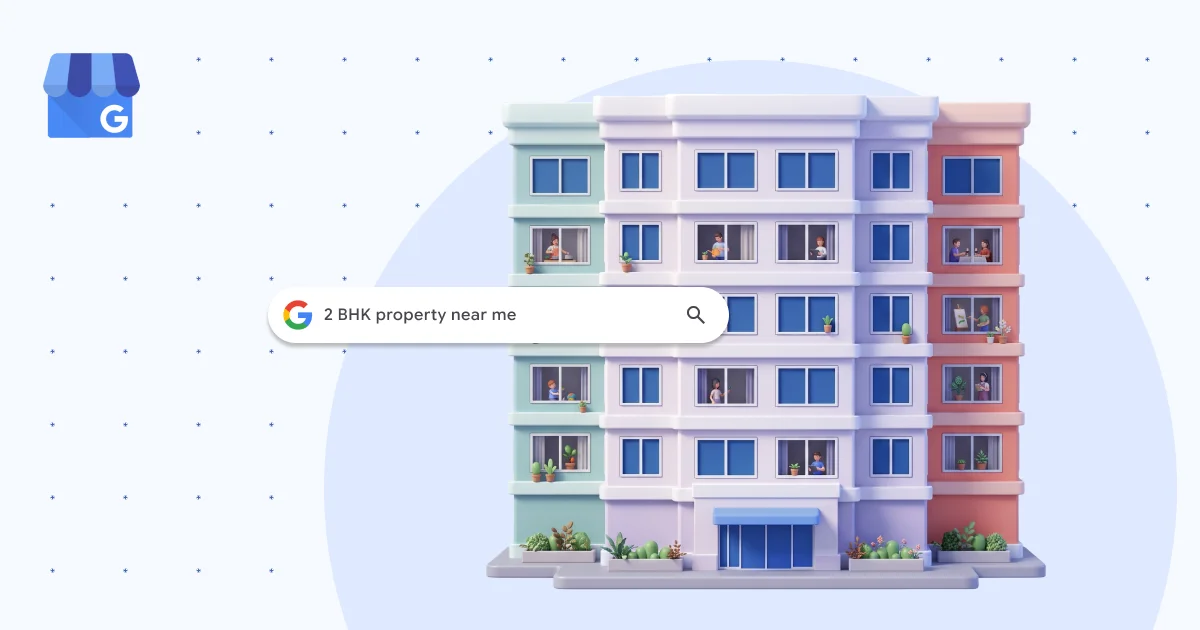
Real estate is one of those industries where trust is everything and the stakes are enormous — most people buy a handful of properties in their entire lifetime, and every single one of those decisions comes loaded with anxiety. So when someone searches “real estate agent near me” or “flats for sale in Baner,” they’re not casually browsing. They’re trying to figure out who they can actually trust with what’s probably the biggest financial decision of their life.
We’ve worked with real estate agents, brokers, and a few developer sales offices at WordPlus, and the pattern is almost identical to what we see everywhere else: strong ground-level reputation, weak digital first impression. A broker doing genuinely good deals for years might still have a GMB profile with two reviews, a blurry office photo, and a category that just says “Real Estate Agency” with nothing else filled in. That’s a real problem, because in this industry, the profile is often doing the trust-building work before a client ever calls.
Why Local Search Carries So Much Weight in Real Estate
Property decisions are hyper-local by nature. Nobody searches “real estate agent” without a location attached — it’s always “property dealer in Wakad,” “flats for rent near Hinjewadi,” “commercial space for lease Pune.” That means the Google map pack is often the very first filter a buyer or tenant applies, long before they visit a website or call a number.
And because real estate transactions involve so much money and legal complexity, buyers do something they don’t do for most local searches — they actually read the reviews carefully, check how long the business has been active, and compare multiple agents side by side before picking up the phone. Your profile needs to hold up under that level of scrutiny.
Step 1: Choose the Right Category, Every Time
Google has fairly specific categories for this industry — “Real Estate Agency,” “Real Estate Consultant,” “Property Management Company,” “Commercial Real Estate Agency,” “Real Estate Developer.” Picking the wrong one, or the generic default, means you’re simply invisible for more specific searches that actually convert better.
If your business genuinely spans multiple services — say residential sales plus rental management — add secondary categories to reflect that. A property management company that only lists itself as a generic “Real Estate Agency” is leaving an entire segment of high-intent searches on the table.
Step 2: Your Business Name Should Match Reality, Not Ambition
Keep the business name exactly as registered and as it appears on your signage and RERA documentation. We’ve seen agencies try to stuff extra keywords into the name field — “XYZ Properties | Best Flats in Pune | 2BHK 3BHK” — and this almost always backfires. Google frequently suspends listings for this kind of keyword stuffing, and honestly, it reads as unprofessional to a buyer who’s about to trust you with lakhs or crores of rupees.
Step 3: Photos Do a Different Job Here Than in Most Industries
For most local businesses, photos show the product or service. In real estate, photos need to do something more specific — they need to establish that you’re a legitimate, established, professional operation, not a fly-by-night broker working out of a two-wheeler and a phone number.
Upload real photos of your office, your team at work, site visits, signed handover moments (with client consent), and if you’re a developer or work closely with specific projects, photos of the actual sites you’ve been involved with. Avoid stock photography of generic glass buildings — anyone who’s spent five minutes browsing real estate listings online can immediately tell when a photo is stock, and it undercuts the very trust you’re trying to build.
Step 4: Reviews Are Doing More Work Than Your Brochure
In an industry built almost entirely on referrals and reputation, Google reviews are simply digitised word-of-mouth, visible to anyone searching your name before they’ve even met you. This is arguably the single highest-leverage thing a real estate business can focus on in their GMB strategy.
A few things worth getting right:
- Time your ask around the deal closing, not before. Right after a successful handover, a signed agreement, or a smooth possession — that’s when a client is most likely to write a genuinely warm, detailed review.
- Encourage specifics. A review that says “Rajesh helped us find a 2BHK within budget in Wakad within three weeks, and handled all the documentation smoothly” carries far more weight with a future buyer than a generic five-star rating with no text.
- Respond to every review, especially the difficult ones. Real estate deals occasionally involve delays, disputes over documentation, or misaligned expectations. A calm, professional public response to a critical review — acknowledging the concern and offering to resolve it directly — often does more for your credibility than a stack of unblemished five-star reviews, because it shows you handle problems like an adult.
- Never use fake or incentivised reviews. This industry already has a trust deficit in many buyers’ minds. Getting caught with manufactured reviews does lasting damage, and Google’s detection systems have gotten noticeably better at catching this pattern.
Step 5: Use the Products and Services Sections Properly
GMB lets you list services, and real estate businesses should use this deliberately — “Residential Resale,” “New Project Sales,” “Rental Management,” “Commercial Leasing,” “Home Loan Assistance,” whatever genuinely applies to your business. Buyers comparing agents in an area are more likely to reach out to the one whose profile clearly signals they handle exactly the kind of transaction being searched for.
If you work with specific ongoing projects or developments, mention them by name where relevant in your description — searches for a specific project name plus “broker” or “agent” are common, and a well-optimised profile can capture that intent directly.
Step 6: Posts — Use Them for New Listings and Market Updates
Most real estate businesses treat GMB as a static listing and completely ignore the Posts feature, which is a genuine missed opportunity. New project launch? Post it. Price appreciation update for a specific locality? Post it. Open house or site visit weekend? Post it with a clear call-to-action.
This does two things — it keeps your profile looking active (which Google’s algorithm tends to reward with better visibility), and it gives serious buyers who are already checking your profile a reason to reach out immediately rather than “thinking about it” and forgetting.
Step 7: Q&A — Answer What Buyers Are Actually Worried About
Seed the Q&A section yourself with the questions that come up constantly: “Do you help with home loan documentation?” “Are the properties RERA registered?” “Do you charge brokerage from both buyer and seller?” “Do you deal in resale as well as new bookings?”
Getting ahead of these questions publicly does two things — it saves you repetitive calls from people just trying to gauge fit, and it signals transparency, which matters enormously in an industry that many buyers approach with some degree of wariness.
Step 8: Track Insights Around Market Cycles
Real estate search interest tends to spike around specific windows — festive seasons like Diwali and Akshaya Tritiya (traditionally considered auspicious for property purchases in many parts of India), financial year-end, and whenever there’s a notable change in home loan interest rates. Check your GMB insights during these periods specifically. A spike in profile views without a corresponding rise in calls usually points to weak listing details, thin review count, or unclear service information — all fixable before the next cycle hits.
Multi-Branch and Multi-Agent Considerations
If you operate across multiple localities or run a team of agents under one brand, each office location needs its own accurately managed profile, and where Google’s guidelines allow it, individual senior agents can benefit from their own profiles too. A single generic listing trying to represent an entire city’s operations dilutes your visibility for hyper-local searches, which is exactly where most real estate search volume actually lives.
Compliance Matters Here More Than Most Industries
Avoid making specific price appreciation guarantees, misleading claims about project approvals, or comparative claims against competing developers or agencies anywhere in your profile description or posts. Beyond the ethical concern, real estate is a heavily scrutinised category, and profiles making unverifiable or exaggerated claims risk suspension, not to mention the reputational damage if a claim doesn’t hold up.
The Real Opportunity Here
Most real estate businesses, even fairly established ones, are still under-investing in their Google presence relative to how much buyer research now happens there before a single phone call is made. That gap is genuinely good news if you’re willing to close it — a well-maintained, review-rich, actively updated profile becomes a real differentiator in a market where most competitors are still treating their listing as a formality they filled out once and forgot about.
At WordPlus Studio, we’ve helped real estate businesses turn their Google Business Profile into an actual lead-generation channel instead of a passive directory entry. If your enquiries have felt inconsistent despite solid deals and happy clients, there’s a good chance the gap is sitting right there in your GMB profile. Happy to take a look at yours on a quick, no-obligation call.
FAQs
What GMB category should a real estate agent choose?
Pick the most accurate one available — “Real Estate Agency,” “Real Estate Consultant,” or “Property Management Company” — rather than a generic default. Add secondary categories if you handle both sales and rentals.
How important are Google reviews for real estate agents specifically?
Extremely important — real estate has always run on referrals, and Google reviews are essentially digitised word-of-mouth that buyers read carefully before ever making a call, given how high-stakes the decision is.
Should each branch office have its own Google Business Profile?
Yes. A single listing trying to represent multiple localities dilutes visibility for hyper-local searches, which is where most real estate search volume actually comes from.
Can real estate businesses mention price appreciation in GMB posts?
Avoid guaranteed appreciation claims or comparisons against competing developers — these can violate Google’s policies and risk suspension. Stick to factual, verifiable project and service information.
Leave a Reply